 Home
Home Shop
Shop  Donate
 Contact
 Lourdes Water
 Español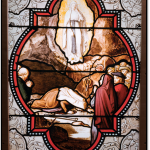
8th Apparition
“All This is Good for Heaven”
St. Bernadette is said to have expressed these words as she clutched her crucifix, accepting her pain and suffering for a final time shortly before her death at St. Gildard convent in Nevers, France, where she spent the last thirteen years of her life. She accepted her sufferings and offered them to God with generosity, even recognizing them as gifts—indeed, they were “good for heaven.” How did she come to this acceptance of the pain and suffering that she experienced throughout her entire life?
On February 24, 1858, during the eighth apparition of the Blessed Virgin Mary in the grotto of Lourdes, Our Lady exclaimed: “Penance!…Pray to God for the conversion of sinners.” Our Lady’s face was sad as she asked Bernadette to kiss the ground for sinners, a task which Bernadette accepted, as she said, with all her heart. The sadness in the eyes of Our Lady revealed to Bernadette the importance of praying and doing penance for the conversion of sinners, which she continued to do for the rest of her life.
We are now in the midst of the Lenten season, where the Church calls us to penance, sacrifice, and pray not just in atonement for our own sins, but as the Chaplet of Divine Mercy prays, “for those of the whole world.” This was a specific request of Our Lady.
What is penance, and how do we engage in it? Sin wounds not just our souls but the entire Church, and most of us are familiar with the penances imposed during the sacrament of reconciliation when the priest assigns a particular penance to make satisfaction for the wounds that we have caused.
There are also voluntary penances that we may offer for our own sins and for the sins of others. As the Catechism of the Catholic Church teaches us, Scripture and the Church Fathers propose three ways to accomplish these penances: fasting, prayer, and almsgiving. We focus on these practices especially during Lent: “Alongside the radical purification brought about by Baptism or martyrdom…as means of obtaining forgiveness of sins: effort at reconciliation with one’s neighbor, tears of repentance, concern for the salvation of one’s neighbor, the intercession of the saints, and the practice of charity ‘which covers a multitude of sins’” (CCC 1434).
We can also accept as a penance our daily trials with abandonment, just like Bernadette. She was not canonized a Saint just because she was chosen to receive an apparition of the Blessed Virgin Mary; rather, it was because of her perseverance in a penitential and holy life during her thirteen years in the convent. Her acceptance of suffering and voluntary acts of penance became the means of her holiness, just as Our Lady asked her to do. As St. Teresa of Avila once proposed in response to our suffering, we can offer it to God in penance and acceptance: “One ‘Blessed be God’ in times of adversity is worth more than a thousand acts of gratitude in times of prosperity.”
As we continue in this season of Lent and look forward to celebrating the conquering of sin and death at Easter, let us keep in the forefront of our minds the importance of Our Lady of Lourdes’ message of sacrifice and penance. All of us are capable of great holiness; perhaps one day we can even come to pray like Bernadette at the end of a penitential life after enduring this vale of tears, “Holy Mary, Mother of God, pray for me, a poor sinner.”
___________________________________
1. René Laurentin, Bernadette Speaks: A Life of Saint Bernadette Soubirous in Her Own Words (Boston: Pauline Books & Media, 2000), 54.
2. Laurentin, Bernadette Speaks, 55.